
Mount Field National Park
Russell Falls and Tasmania's Oldest National Park
On the lands of the Big River people.
schedule 1 min read / Updated Apr 2026
Tasmania's oldest national park, an hour and a half north-west of Hobart. Russell Falls, a tiered cascade dropping through tree-fern gullies, is one of the most photographed waterfalls in the country.
Mount Field was declared a national park in 1916 (along with Freycinet on the east coast), making it the oldest in Tasmania. The park is shaped like a layered cake, with the temperate rainforest of the Derwent Valley at its base, a high alpine plateau on top, and a transition zone of swamp gum forest in between.
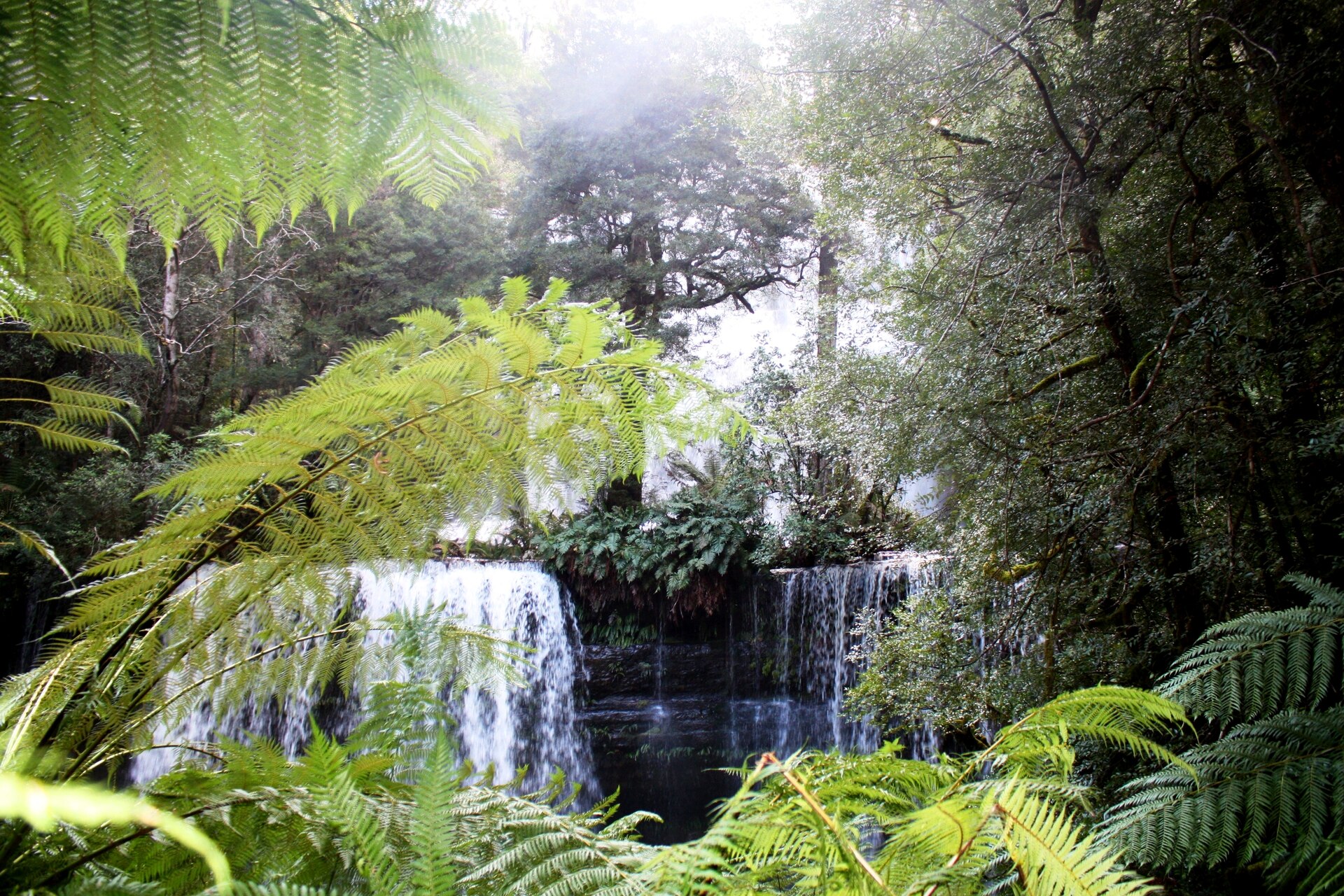
Russell Falls, in the lower section of the park, is the iconic image. The falls drop in three tiers through a fern gully and are reached by a flat 25 minute return walk on a sealed path from the visitor centre. The track continues uphill to Horseshoe Falls and Lady Barron Falls if you want a longer walk (the Three Falls Circuit is around 6 km return).
Further up, Mount Field West is the high alpine section. In autumn the deciduous beech (the only deciduous native tree in Australia) turns brilliant gold for two weeks in late April and early May. In winter the area is the closest snow country to Hobart.
Common questions
Things visitors ask about Mount Field National Park.
Quick answers to help you plan.
Where is Mount Field National Park?
expand_more
Mount Field National Park sits in southern Tasmania, roughly 75km north-west of Hobart via New Norfolk and Westerway. The visitor centre and main entrance are at the small township of National Park, on the edge of the Tyenna Valley. From there a sealed road climbs to the lower park, with an unsealed road continuing 15km up to Lake Dobson in the alpine zone.
How long does it take to drive from Hobart?
expand_more
Allow about 75 minutes for the 73km drive from Hobart to the Mount Field visitor centre. The route follows the Lyell Highway through New Norfolk before turning off at Westerway. It is an easy day trip, although many visitors stay overnight to see Russell Falls lit up by glow worms after dark.
Is Mount Field really Tasmania's oldest national park?
expand_more
Yes. Mount Field was proclaimed a national park in 1916, on the same day as Freycinet, making the pair Tasmania's first national parks. The Russell Falls area was protected even earlier, set aside as a nature reserve in 1885. That gives the park more than a century of continuous conservation history.
How easy is the walk to Russell Falls?
expand_more
Russell Falls is one of Tasmania's most accessible waterfalls. The walk from the visitor centre is just 1.4km return on a sealed, wheelchair-friendly path through tall rainforest, taking around 25 minutes. The three-tiered cascade is the park's signature image and can also be visited at night to spot glow worms in the damp recesses beside the track.
What other walks are worth doing in the lower park?
expand_more
The Tall Trees Walk is a 1km loop of about 30 minutes through groves of swamp gum (Eucalyptus regnans), the world's tallest flowering plants. Many visitors combine Russell Falls, Horseshoe Falls, the Tall Trees Walk and Lady Barron Falls into a single circuit of around two hours. All three waterfalls flow strongest in winter and spring after rain.
Do I need to pay to enter Mount Field?
expand_more
Yes, a Tasmania Parks Pass is required for every vehicle. A daily pass is $47.70 per vehicle (up to 8 people), a holiday pass valid for two months is $95.50, and an annual all-parks pass is $101.70. Passes can be bought online before you travel or at the Mount Field visitor centre on arrival.
What is the Tarn Shelf and when should I walk it?
expand_more
The Tarn Shelf is a string of glacial lakes set into the alpine plateau in the upper park, reached from Lake Dobson. The full circuit is about 12km and takes 5 to 7 hours, rated Grade 3. Late April is the peak window, when the deciduous beech (fagus, Nothofagus gunnii) turns gold, orange and red across the hillsides, an event Tasmanians call "the turning of the fagus".
Can you really ski at Mount Field?
expand_more
Yes, in good seasons. Mount Mawson, in the upper park, is one of only two ski fields in Tasmania and is run by the volunteer Southern Tasmanian Ski Association. Three rope tows operate on weekends and public holidays when there is enough snow, typically between mid-July and mid-September.
What wildlife might I see in the park?
expand_more
Mount Field is one of the easier places in Tasmania to spot native wildlife. Bennetts wallabies, Tasmanian pademelons, possums, wombats and echidnas are commonly seen around the campground and picnic areas, particularly at dusk. The park is also home to Tasmanian devils, eastern quolls and platypus, although these are far harder to glimpse.
When is the best time of year to visit?
expand_more
Mount Field is genuinely a four-season park. Spring brings the heaviest waterfall flows, summer suits the longer alpine walks, late April delivers the famous fagus colour change on the Tarn Shelf, and winter dusts the upper park with snow for skiing at Mount Mawson. The lower park near Russell Falls stays open and walkable year round.
Where can I stay near Mount Field?
expand_more
Inside the park you can camp beside the Tyenna River at Mount Field campground or book one of the Government Huts in the alpine area near Lake Dobson. Just outside the boundary, the township of National Park has cabins and a hotel, while Westerway and Maydena (a short drive west) offer cottages and B and Bs that suit visitors also exploring the Florentine Valley and Maydena Bike Park.
Whose Country is Mount Field National Park on?
expand_more
Mount Field lies on the Country of the palawa peoples of lutruwita (Tasmania), within the territory of the Big River nation, whose lands stretched from the Great Western Tiers to kunanyi / Mount Wellington. Archaeological evidence in the nearby Florentine Valley shows Aboriginal occupation of the region for more than 35,000 years.
Featured in
Shortlists that include Mount Field National Park.

Scenic views
Lookouts near Mount Field National Park.
You may also like

Franklin-Gordon Wild Rivers National Park
Russell Falls

Museum of Old and New Art (MONA)

Huon Valley

kunanyi / Mount Wellington
Southwest National Park
Hobart

Hartz Mountains National Park

Richmond
Richmond
Bruny Island

Ross
Attribution
Sources & credits
Content (4)
- Wikipedia: Mount Field National Park · CC BY-SA 4.0
- Mount Field National Park · Parks and Wildlife Service Tasmania
- Park passes and entry fees · Parks and Wildlife Service Tasmania
- Mount Field National Park visitor guide · Tourism Tasmania
Images (2)
- Blue Lake in Mount Cook National Park.jpg · Krzysztof Golik · CC BY-SA 4.0
- Lady Barron Falls Mt Field National Park.jpg · JJ Harrison (jjharrison89@facebook.com) · CC BY-SA 3.0


Images sourced from Wikimedia Commons under licenses that permit commercial use. If you are the rights holder and believe an attribution is incorrect, please contact us.